CHOCOLATE MOUSSE TORTE


Chocolate Mousse Torte


Prep Time: 20 min (plus refrigeration)

Makes 16 servings

Ingredients

  • 18           Lady Fingers
  • 4             squares Baker’s Semi-Sweet Chocolate
  • 2             pkg (3.9 oz each) Jello  Chocolate Instant Pudding
  • 2             cups plus 2 tablespoon cold milk
  • 1             tub (8oz.) Cool Whip Whipped Topping, thawed
  • 1             pkg. (8oz.) Philadelphia Cream Cheese, softened
  • ¼           cup sugar
  • ¾           cup fresh raspberries
  1. Cut lady fingers in half and line inside edge of 9-inch round pan lined with plastic wrap.
  2. Melt 3 chocolate squares over a hot bath.
  3. Beat pudding mixes and 2 cups milk in medium bowl with whisk 2 min. Add melted chocolate; mix well. Stir in 1 cup Cool Whip; pour into prepared pan.
  4. Beat cream cheese, sugar and remaining milk with mixer until well blended. Stir in 1 cup of remaining Cool Whip; spread over pudding. Top with remaining lady fingers. Refrigerate 3 hours. Meanwhile, shave remaining chocolate square into curls.
  5. Invert torte onto a plate. Remove pan and plastic wrap. Top torte with remaining Cool Whip, berries and chocolate curls.

250 ml whipped cream can be substituted for Cool Whip.

Chapatti

Chapatti  is generally a South Asian bread made from stone ground whole meal flour, traditionally known as Atta flour.  Chapattis are one of the most common forms in which wheat, the staple of northern South Asia, is consumed.  Chapatti is a form of roti or rotta (bread). The words are often used interchangeably. While roti,rotta refers to any flat unleavened bread, chapati is a roti made of whole wheat flour and cooked on a tava (flat skillet).

Cooking


A roadside chapatti stand in               Indian Tava

Mandalay, Myanmar. .

Often, the top of a chapatti is slathered with butter or ghee (clarified butter). A piece of chapatti is torn off and used to pick up the meat or vegetable dish(es) that make the meal. It is folded into a sort of loose cone and used as a scoop to eat the more liquid dishes at a meal..

Chapatti sizes (diameter and thickness) vary from region to region and kitchen to kitchen. . Chapattis made in domestic kitchens are usually not larger than 6-7 inches in diameter since the ‘tava’ on which they are made comes in sizes that fit comfortably on a domestic stove top.

Tavas were traditionally made of unglazed earthenware, but are now typically made from metal. There are also electric tavas manufactured in India. The shape of the rolling pin also varies from region to region. Some households simply use a kitchen work top as a sort of pastry board, but many homes have round flat-topped ‘boards’ specifically for rolling out chapattis that may be made of wood or stone.                                                                           Roti 2Roti 1                                       


Roti 4   Roti 3

Ingredients                      

  • 2           cup whole wheat flour
  • 4           tbsp vegetable oil
  • 1           cup water

Instructions

  1. Put the flour in a medium bowl, add the oil and rub it in the flour.
  2. Add the water(you may need a little more)  and make a firm dough. Transfer the dough on a floured board and kneed for about 2 minutes.  Let it rest for 10 minutes. (If you let the dough rest, it is easier to roll).
  3. Divide the dough into 12 and make small balls.
  4. Roll each ball in flour, flatten the ball and roll it into an eight inch round.
  5. Cook this on a tava on both sides. (You have to turn it a couple of times on both sides)
  6. Brush the chapatti with butter or ghee.

Prawn Bhatt

Ingredients

  • 2               lb prawns  (16 to 25 count)
  • 3               cups rice
  • ¼              cup oil
  • ½              tsp  cumin seeds
  • 5               cardamom pods
  • 1               piece cinnamon stick
  • 5               cloves
  • ½              tsp black pepper
  • 4               med potatoes
  • 4               med onions sliced
  • 4               tomatoes
  • 1               bunch fresh Coriander leaves
  • 1               bunch fresh dill weeds
  • 2               jalapeño (or to taste)
  • 1               tsp garlic paste
  • 1               tsp ginger paste
  • 2               tsp coriander & cumin powder(dhanajeera)
  • ½              tsp turmeric powder (haldi)
  • 3               tsp salt
  • 1               can(397ml) coconut milk
  • 2               fresh lemon
  • 1/2            tsp garam masala

Instructions

  1. Peel the prawns and devein them.  Add the juice of a lemon and 1 tsp salt and let it rest.
  2. Soak the rice in cold water.
  3. Peel the potatoes and cut them in quarters.
  4. In a large saucepan heat oil and add cumin seeds, cardamom pods, cinnamon sticks, cloves, black pepper, and onions.  Fry till they are transparent.
  5. Meanwhile In a blender, blend tomatoes, half  bunch coriander leaves and half a bunch dill weeds and jalapeño.  Add this to the onions. 
  6. Add  coriander & cumin powder, turmeric powder, salt and coconut milk.
  7. Mix everything, turn down the heat to medium and let this simmer for about 15 minutes or the sauce is thick.  Squeeze the juice of 1  lemon. 
  8. Chop the coriander leaves and dill weeds and add this to the sauce.
  9. Rinse the rice with cold water.
  10. Take a third of the sauce out in another large saucepan.  Add 41/2 cups of water and boil.  Add the rice and potatoes.  When the rice starts to boil turn the heat to low and cook  covered till most of the water has evaporated.  Sprinkle garam masala and put the saucepan in the preheated 350 degree oven for 15 minutes or till the rice is cooked and dry.
  11. Rinse the prawns with cold water, drain and add this to the rest of the sauce and cook for about 10 minutes or till the prawns are cooked.  Prawns are cooked when they become pink and the prawns curls  up into a round.

To Serve

Serve rice on a platter and put the prawns on top. 

Decorate it with  chopped coriander leaves on it and lemon butterflies.

Falooda/Faluda

Agar-agar is a natural vegetable gelatin substitute produced from a variety of seaweed vegetation. White and semi-translucent, it is sold in packages as washed and dried strips or in powdered form. Agar-agar is approximately 80% fiber, so it can serve as an intestinal regulator.

Agar Agar is sold in health food stores, Chinese grocery stores,and Indian stores, in both flake and powder varieties, and can be used in a variety of dairy-free and vegan recipes as a stabilizing and thickening agent for custards,puddings, sauces and even vegetarian marshmallows.

Falooda


Ingredients

  • 4              cups half and half
  • 1              can (370 ml) evaporated milk
  • 3/4           cup sugar (or to taste)
  • 2-1/2        level tsp Agar agar powder
  • 1/2           tsp crushed cardamom seeds
  • 1/4           tsp nutmeg powder
  • 1/8           tsp pink colorer 1/4 tsp saffron

For decoration

  • 1/4 cup chopped almonds and pistachios
  • 1/4 cup pomagrate seeds

Instructions

  1. Mix everything and boil it. When it starts to boil remove it from the stove, pour it in a serving bowl and cool it before you put it in the fridge.
  2. Decorate with almonds and pistachios before serving.

You can set this in a medium size bowl or 4- 8 oz bowls.

If you are using the grass agar agar, soak it in a cup of water for 2 hours, then boil it on medium heat until it completely dissolves and then add it to the warm milk and boil the mixture.

Variations

You can use 1/4 tsp saffron instead of the pink colour.

Agar Agar Powder

My Profile

I am a third generation born in East Africa. My Maternal grandparents were born in Kenya, my mother was born in Uganda, and I was born in Uganda. My paternal grandparents came from Gujarat in India, my father was born in Uganda. I am the eldest of the 4 siblings. We lived in a small village in Uganda and I went to school in Kampala and stayed with my paternal grand parents. During the holidays when we went home,my mother entertained us by teaching us how to cook, sew, knit, crochet and embroidery. We had to make all our snacks as there were no cafes nearby, so I learnt to make cakes and breads too.

I did my elementary school in Uganda and my high school in Kenya. My parents bought a farm and moved to Kenya. I went to a boarding school. On the farm we had no shortage of eggs, milk, cream, butter and ghee. We grew a lot of vegetables and fruit. When in season we had a lot of corn and wheat too. My mom made new friends and was introduced to a lot of different foods and vegetables including marmalades and jams. From junior high to high school I studied home economics and learnt to cook different foods and baking. After high school I went to London, England. In England I was introduced to a lot of different cuisines and met a lot of people from different cultures. We exchanged recipes and learnt about each others cultures.

I moved to Canada in early seventies and stayed with my maternal grand parents till I got married, and learnt some more from her. What I did not learn from my mum, I learnt from my grandmother and mother-in-law.

My husband comes from Kenya, my mother-in-law was born in Kenya, my father-in-law came from Pakistan. My in-laws ran a restaurant in Nairobi called Curry Pot. I learnt some things from them. My brother-in-law is married to an Irish woman, from whom I learnt to celebrate Christmas and Easter. My father-in-law’s family is from Pakistan and Ceylon and I have learnt about their culture and traditions as well.

I have traveled half the world to be in Canada and on the way picked up a lot of different cuisines.

I have a daughter and a son and I was a stay at home mum, so I started catering from home and made cornish pasties, chicken pies and cakes, (plain, birthday and wedding). I also start catering for a deli.I made cornish pies and chicken pies for them. In mid eighties I opened a restaurant called Cafe Nairobi in partnership with my sister-in-law where we did a lot of catering for private parties and weddings. I then joined the school board and worked in their Lunch program. I also went to Vancouver Vocational College and took a chef’s course. I taught Indian cooking in the evening at an adult learning centre in Vancouver. I retired from the board and opened a restaurant called Heavenly Bites where we did Tiffin’s and take out, and catered for parties. I also supplied a deli with samosas.

I am now retired. I have a daughter who is a dietician and a pastry chef and she helps with my recipes.

Dipping Sauce

for Salad Roll

Ingredients

  • 3             medium carrots, peeled and coarsely chopped
  • 1             small shallot, quartered
  • 2             tbsp coarsely grated peeled fresh ginger
  • 1/4         cup rice-wine vinegar (not seasoned)
  • 2             tbsp low-sodium soy sauce
  • 1/4          tsp toasted sesame oil
  •                Pinch of course salt and freshly ground pepper  
  • 1/4          cup vegetable oil
  • 1/4          cup water

Instructions

  1. Puree carrots,shallot,ginger, vinegar,soy sauce,sesame oil, salt, and pepper in a food processor until smooth.  With machine running, add vegetable oil and then water through the feed tube in  slow, steady stream. 

Chicken Pies

 Chicken Pies


Ingredients   

  • 1                   chicken (about 3-4 lbs)
  • 1                   tsp garlic paste
  • 1                   tsp ginger paste
  • 1                   medium onion
  • 2                   sticks celery
  • 1/2                tsp salt
  • 1/2                tsp black pepper
  • 1                   can sliced mushrooms
  • 1                   can cream of mushroom soup
  • 1                   pkg frozen  puff pastry (395 gms)
  • 1                   egg

Instructions

  1. Skin and cut the chicken in quarters, remove all the fat and rinse it in cold water.  In a medium sauce pan put 4 cups of water, garlic,  ginger,  1/2  tsp salt and the chicken and boil it for about half an hour.  Remove the chicken and let it cool.  Remove the bones and cube the chicken in small pieces.
  2. Peel the onion and chop it finely, chop the celery finely.
  3. In a medium saucepan melt the butter, sauté the onions and celery.  Drain the mushrooms and add this to the saucepan,  Add the mushroom soup.  Add the chicken, 1/4 cup of the chicken stock, 1/2 tsp salt, black pepper and mix it well.  Remove from the heat and cool it in the fridge.
  4. Beat the egg with 2 tbsp water.
  5. Roll out the pastry to 1/8” thickness,  with a 3” cookie cutter cut the rounds.  Reroll  the scrapes and do the same.  Use the reroll rounds  for the bottom of the pastry.  Put a teaspoon of filling in the centre of the round, brush the sides with egg wash and cover it with a round on top.  Press the sides with a fork.
  6. Put the pastry on a cookie sheet, egg wash it and bake in a preheated 400 degree  oven for 30 minutes(it should be golden brown in colour)


“

Dhokla/Dokra

Dhokla (also spelt Dhokra or Dokra)) is a vegetarian dish that originated in the state of Gujarat in India.  It can be served for breakfast, or as a side dish,a main course or a teatime snack.  It can be served hot, cold, or at room temperature.  It is made with fermented batter made of gram flour(chickpeas)  rice and yoghurt.  The main ingredient is rice.

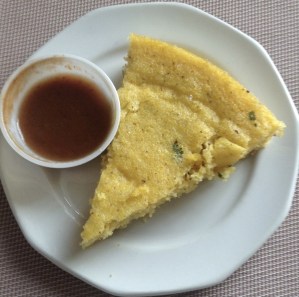
Dhokla is a savory cake that is steamed.

My mum used to make dhoklas for breakfast. Any left over,  we would have at teatime.  A hot garlic chutney is served with it.

Somebody came up with instant dhokla which are easier to make and you do not ferment it overnight.  Instant dhoklas are made with Sooji (wheatlets) or cornmeal.  I make it with sooji, If you are  allergic to wheat, use cornmeal.

Sooji is also known as Semolina or wheatlets

1.Semolina is the coarse, purified wheat middling’s of durum wheat used in making pasta  and also used for breakfast cereals  and puddings.  Semolina is also used to designate coarse middling  from other varieties of wheat, and from other grains such as rice and corn.

Semolina

Dokra

  •  

  •  


Ingredients

  • 1                    cup sooji
  • 2                    tablespoon Channa Flour
  • 5                    tablespoon Yoghourt
  • ½                   teaspoon Black Pepper (freshly ground)
  • ½                   teaspoon Cumin (freshly ground)
  • ½                   teaspoon Fenugreek Seeds
  • 1                    tsp sugar
  • 1                    tsp Citric Acid
  • ½                   tsp salt
  • ¼                   cup oil
  • ¼                   tsp ground ginger
  • ¼                   tsp ground garlic
  • ¼                   tsp ground jalapeno
  • ½                   tsp chopped fresh coriander leaves
  • ½                   cup warm water
  • 1 ½                tsp  rounded Baking Powder

Instructions

  • In a large sauce pan pour about 2 inches of water and boil.  The water should be boiling when you put the dhokla in.  The saucepan should be about 10 inches wide.  Put a wok ring inside the saucepan, the dhokla dish should sit on this ring. 
  • Add  everything except Baking Powder and mix well.(The mixture should be running consistency like a cake). 
  • Add Baking Powder and mix well. 
  • Pour into a greased 8” sandwich tin.
  • sprinkle chilly  powder on it.
  • Steam for 20 min.

Serve with Garlic Chutney.

Omelette Roll

A dish consisting of beaten eggs cooked until set.  It can also be folded over with a filling inside.

Omelette  Roll is a chapatti rolled with an omelette.  It is breakfast on the go or lunch for the kids.  It is nutritious and easy to pack.

Omelettes are easy to make but are a little tricky.  You need practice to make it perfect.  Making a roll is the best place to start because if you break the omelette  nobody will know.

You can make your chapatti or buy it from Indian Grocery Stores.

Omelette Roll

Omelet

Ingredients

  • 1                   egg
  • 1                   tbsp water
  • 1                   tsp finely chopped onion
  • 1/4                tsp finely chopped cilantro
  • 1/8                tsp salt
  • 1/2                tsp butter
  • 1 chapatti

Instructions

  1. In a small bowl, combine  egg, water onions, cilantro and salt  and beat with a fork till everything is mixed together.
  2. Melt butter in a frying pan over medium heat, pour the egg batter and tilt the pan to spread it around.  When it starts to set, loosen it with a palette  knife, turn it over and cook on the other side for about 1 minutes.
  3. Place the omelet on the chapatti and roll it up.
  4. Wrap it in a napkin.

Variations

  • Sugar roll:            Spread butter on the chapati sprinkle with        sugar and roll it up.
  • Banana Roll:         Spread butter, sugar and a banana and roll it up.
  • Aloo Roll:             If you have  leftover Alo curry (Potato) use that and roll up the chapatti.

Chicken Tikka Pita Pockets

Makes 36

Chicken Tikka Pita Pockets


Ingredients

  • 1            Chicken breast, boneless and skinless
  • 2            tbsp Yogurt
  • 2            tsp Green Masala
  • 1/2         tsp Salt
  • 1            tsp Tomato Paste
  • 1/2         tsp Black Pepper freshly ground
  • 1/2         tsp  Cumin freshly ground
  • 1            tbsp Lemon Juice
  • 1            tbsp oil
  • 1            pkt Pita Bread Small size (18 pieces)
  • 4            leaves iceberg Lettuce

Directions

  1. Remove all the fat from the chicken and rinse it with cold water.  Cut chicken breast into 1/4 inch stripes and then cut the strips in 1/2 inch pieces.  Marinate it with yogurt, green masala, salt, black pepper, cumin and lemon juice.
  2. In a frying pan heat the oil and add the marinated chicken and cook till the chicken is firm.  (chicken is done when it changes color and it is firm to the touch).  Let it cool.
  3. Finely cut the lettuce leaves.
  4. Cut the pita in halves,fill the pita with a little lettuce leaves and 2 tsp of chicken mixture.
  5. Drizzle it with yogurt riata and tamarind sauce.